admin
admin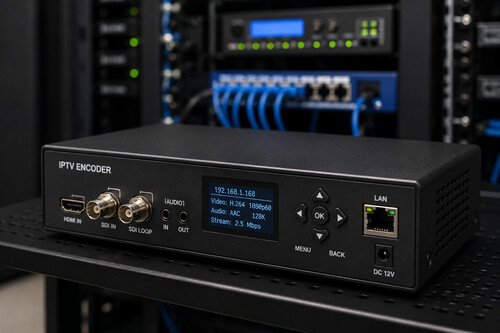
As video distribution continues to move toward network-based systems, IPTV video encoders have become an essential part of modern audiovisual infrastructure. They allow traditional video sources, such as cameras, media players, computers, receivers, or production switchers, to be converted into digital streams that can be delivered over an IP network. An IPTV video encoder processes video and audio signals, compresses them, and prepares them for transmission to televisions, set-top boxes, computers, mobile devices, streaming servers, or IPTV platforms. Thanks to this process, one video source can be distributed efficiently to many viewers across a local network, private system, or internet-based environment. This article explains what IPTV video encoders are, how they work, where they are used, and why they are important in hospitality, education, corporate communication, live streaming, broadcasting, healthcare, surveillance, and digital signage systems. It also presents their main advantages, limitations, and the key factors to consider when choosing the right encoder for a specific installation.
What Are IPTV Video Encoders?
IPTV video encoders are devices or software systems used to convert video and audio signals into digital streams that can be delivered over an IP network. In simple terms, they take a video source, compress it, package it into a network-friendly format, and send it to viewers through local networks, private networks, or the internet.
IPTV stands for Internet Protocol Television. Unlike traditional television distribution, which often uses satellite, terrestrial broadcast, or coaxial cable systems, IPTV delivers video through data networks. This makes IPTV video encoders essential in modern broadcasting, live streaming, hospitality systems, education, corporate communication, surveillance, healthcare, and digital signage.
An IPTV video encoder acts as the starting point of an IP-based video distribution system. Without encoding, raw video signals from cameras, media players, computers, or receivers would usually be too large and unsuitable for efficient network transmission. The encoder prepares the signal so that it can be received by IPTV set-top boxes, smart TVs, computers, mobile devices, streaming servers, or media players.
How IPTV Video Encoders Work
The main task of an IPTV video encoder is to receive an input signal and convert it into a compressed digital stream. The input may come from many different sources, such as a camera, HDMI device, SDI source, media player, computer, video mixer, or broadcast receiver.
Once the signal enters the encoder, the device processes the video and audio. The video is compressed using a codec, which reduces the amount of data needed to transmit the image. Audio is also compressed and synchronized with the video. After compression, the encoder packages the data into a streaming format and sends it over an IP network.
This process allows high-quality video to be transmitted efficiently. Without compression, video files and live signals would require very large amounts of bandwidth. Encoding makes it possible to deliver video to multiple viewers without overwhelming the network.
Depending on the system, the stream may be sent as multicast, unicast, or adaptive streaming. Each method has different advantages and is used in different types of IPTV installations.
The Role of Compression
Compression is one of the most important functions of an IPTV video encoder. Raw high-definition video contains a huge amount of data. Sending it directly over a network would be impractical in most installations. Compression reduces the size of the video stream while trying to preserve as much visual quality as possible.
The encoder analyzes the image, removes unnecessary or repeated information, and creates a smaller data stream. For example, if only a small part of the image changes from one frame to the next, the encoder does not need to resend the entire image in full detail every time. Instead, it can describe the changes more efficiently.
The balance between quality and bandwidth is a key consideration. Higher quality usually requires more bandwidth. Lower bandwidth settings reduce network load but may result in visible compression artifacts, lower detail, or reduced motion quality.
A properly configured IPTV encoder should match the quality requirements of the application and the capacity of the network.
Common Input Sources
IPTV video encoders are used with many types of video sources. One common source is a live camera. In this case, the encoder converts the camera signal into an IP stream for live viewing, recording, or distribution.
Another common source is a media player or computer. This is useful for digital signage, presentations, training materials, or scheduled video content. The encoder can take the video output and make it available as an IPTV channel.
Broadcast receivers can also be connected to encoders. This allows television channels or satellite feeds to be converted into IP streams and distributed through a local IPTV system.
In live production environments, an encoder may receive the final program output from a video switcher. This allows the complete live production to be streamed to viewers, displayed throughout a venue, or recorded by a network-based system.
Security systems may also use IPTV encoders to convert camera feeds into streams that can be monitored from different locations.
IPTV Encoders in Hospitality
Hotels and resorts often use IPTV systems to deliver entertainment, information, and internal content to guest rooms. IPTV video encoders allow locally generated content to be added to the system.
For example, a hotel may create a welcome channel, event schedule, restaurant information channel, or promotional video feed. The source content is connected to an encoder, converted into an IP stream, and distributed through the hotel network.
This allows the hotel to manage content centrally. Instead of updating each television individually, the content source can be changed in one location. Guests can then access the content through the IPTV interface or channel list.
IPTV video encoders also help hotels integrate live events, conference broadcasts, or custom information channels into their room entertainment systems.
Use in Education
Schools, universities, and training centers use IPTV video encoders for lectures, announcements, campus television, remote learning, and event broadcasting. A classroom camera or lecture capture system can be connected to an encoder and streamed across the campus network.
This makes it possible for students to watch live or recorded lectures from different rooms or locations. Large campuses may use IPTV encoders to distribute educational channels, emergency messages, graduation ceremonies, sports events, or internal programming.
Because IPTV uses network infrastructure, educational institutions can manage video distribution more flexibly than with traditional AV cabling. Encoders help convert real-world video sources into streams that can be used by learning platforms, display systems, or internal media servers.
Corporate and Business Applications
In corporate environments, IPTV video encoders are often used for internal communication, training, live meetings, executive announcements, and digital signage. A company may use encoders to stream presentations from meeting rooms to offices in different locations.
For large organizations, IPTV video encoders can support centralized communication. Important announcements can be broadcast to displays throughout a building or shared with remote employees through a secure network.
Encoders are also useful in conference centers and event venues. They can convert camera feeds, presentation outputs, or mixed program signals into IP streams. These streams can then be sent to overflow rooms, recording systems, web platforms, or internal display networks.
Broadcast and Live Streaming
IPTV video encoders are a core part of many live streaming workflows. In a live production, the final video signal is sent from a camera or switcher into an encoder. The encoder compresses the signal and sends it to a streaming server, content delivery platform, or private IPTV network.
Live streaming requires stable encoding because viewers expect continuous playback. The encoder must maintain synchronization between audio and video, handle motion smoothly, and produce a stream that receiving devices can decode reliably.
Some encoders are designed for constant operation in professional environments. They may support multiple streams, redundant network connections, adjustable bitrates, and monitoring features. These functions are useful when reliability is critical.
Multicast and Unicast Streaming
IPTV video encoders may support different streaming methods. Two of the most important are multicast and unicast.
Multicast is commonly used in closed IPTV networks, such as hotels, hospitals, campuses, or corporate buildings. With multicast, one stream can be sent across the network and received by many devices at the same time. This is efficient because the encoder does not need to send a separate stream to each viewer.
Unicast works differently. In a unicast system, each viewer receives an individual stream. This can be useful for internet streaming or systems where users request content separately. However, unicast uses more bandwidth as the number of viewers increases.
The best method depends on the network design and viewing requirements. Multicast is efficient for large local IPTV systems, while unicast is often better suited for remote or individual viewing.
Adaptive Streaming
Some IPTV video encoders support adaptive streaming. Adaptive streaming creates multiple versions of the same video at different quality levels and bitrates. The viewer’s device then selects the best version based on network conditions and screen size.
This is especially useful for internet-based viewing, where connection speeds may vary. If the network becomes slower, the player can switch to a lower bitrate stream to avoid buffering. If the connection improves, it can switch back to a higher-quality version.
Adaptive streaming is less common in simple closed IPTV systems but is very important for broader online delivery and multi-device viewing.
Video Quality and Bitrate
One of the most important settings in an IPTV video encoder is bitrate. Bitrate determines how much data is used to represent the video stream. Higher bitrates usually provide better quality but require more network bandwidth. Lower bitrates reduce bandwidth use but may reduce image quality.
The ideal bitrate depends on resolution, frame rate, type of content, and network capacity. A talking-head presentation can often look good at a lower bitrate because there is limited movement. Sports, concerts, and fast-moving video usually need higher bitrates to maintain quality.
Resolution is also important. Standard definition, high definition, and ultra-high-definition streams have different bandwidth needs. The encoder should be configured according to what the receiving devices and network can support.
A well-balanced IPTV system should provide clear video without overloading the network.
Audio Encoding
IPTV video encoders also process audio. The audio may come through the same input as the video or through separate audio connectors. The encoder compresses the audio and combines it with the video stream.
Audio quality is important, especially for lectures, meetings, events, and entertainment. Poor audio can make a video stream difficult to understand even if the image quality is good.
The encoder must keep audio and video synchronized. If audio delay occurs, viewers may notice that speech does not match lip movement. Professional encoders usually provide settings to help maintain synchronization and adjust audio levels.
Latency
Latency is the delay between the original video source and what the viewer sees. All encoding systems introduce some amount of latency because the video must be processed, compressed, transmitted, and decoded.
In many IPTV applications, a short delay is acceptable. For example, hotel information channels, digital signage, training content, and general entertainment do not usually require instant delivery.
However, low latency is important in live events, security monitoring, interactive presentations, and real-time communication. In these cases, encoder settings must be chosen carefully. Lower latency may require different compression settings, higher bandwidth, or specific streaming protocols.
The right balance depends on the application. Lower latency can sometimes reduce compression efficiency, while higher compression efficiency may increase delay.
Network Requirements
An IPTV video encoder depends on the quality of the network. Even the best encoder cannot deliver stable video if the network is poorly designed or overloaded.
Important network factors include bandwidth, switch capacity, multicast support, packet loss, and traffic management. In professional IPTV systems, network equipment must be configured to handle video streams reliably.
For multicast IPTV, switches may need proper multicast management to prevent unnecessary traffic from flooding the network. For internet streaming, upload bandwidth and connection stability are critical.
Network planning should always be part of IPTV encoder installation. The number of streams, bitrate of each stream, number of viewers, and type of delivery must all be considered.
Hardware Encoders vs. Software Encoders
IPTV video encoders can be hardware-based or software-based.
Hardware encoders are dedicated devices built specifically for video encoding. They are often used in professional and permanent installations because they are stable, compact, and designed for continuous operation. They usually have physical video inputs and network outputs.
Software encoders run on computers or servers. They can be flexible and powerful, especially when many processing options are needed. However, they depend on the performance and stability of the computer system.
The choice between hardware and software depends on the use case. Hardware encoders are often preferred for reliability and simplicity. Software encoders may be preferred for flexible workflows, complex processing, or temporary streaming setups.
Advantages of IPTV Video Encoders
IPTV video encoders offer many advantages. They make it possible to distribute video over standard network infrastructure. This reduces the need for specialized AV cabling and allows video to be managed through existing IP systems.
They also support centralized content distribution. A video source can be encoded once and delivered to many viewers, rooms, buildings, or devices. This is useful for hotels, hospitals, schools, companies, and venues.
Another advantage is flexibility. IPTV streams can be viewed on different types of devices, depending on the system design. They can also be recorded, monitored, redistributed, or integrated with other digital platforms.
IPTV encoders also make it easier to add local content to a television or streaming system. Live cameras, presentations, media players, or internal channels can all be converted into IP streams.
Limitations and Challenges
Despite their benefits, IPTV video encoders have limitations. The first challenge is configuration. Resolution, bitrate, codec, audio format, streaming protocol, and network settings must be chosen correctly.
Another challenge is network dependency. If the network is unstable, the video stream may freeze, buffer, or fail. This is why professional IPTV installations require careful network planning.
Compatibility can also be an issue. The encoder’s output format must be supported by the receiving devices, media players, or IPTV platform. If the codec or protocol is not supported, the stream may not play.
Latency is another factor. Some applications require very low delay, while others can tolerate more. Choosing the wrong settings may affect the viewer experience.
Choosing the Right IPTV Video Encoder
When selecting an IPTV video encoder, the first step is to identify the input source. The encoder must support the required video connector and signal format. The next step is to determine the output requirements, including codec, resolution, bitrate, and streaming protocol.
The number of channels is also important. Some encoders handle one input, while others can encode multiple video sources at the same time. For larger systems, multi-channel encoding can save space and simplify management.
Reliability should also be considered. In systems that operate continuously, the encoder must be stable and easy to monitor. Features such as remote management, stream status information, and automatic recovery can be valuable.
Finally, the encoder should match the network and receiving devices. A technically advanced encoder is only useful if the rest of the system can support its output.
IPTV video encoders are essential components in modern IP-based video distribution. They convert video and audio signals into compressed digital streams that can be delivered over networks to televisions, computers, media players, mobile devices, streaming servers, or IPTV platforms.
They are used in hospitality, education, corporate communication, broadcasting, live streaming, healthcare, surveillance, digital signage, and many other applications. Their main purpose is to make video easier to distribute, manage, and view across different locations and devices.
By compressing video, preparing it for network transmission, and supporting different streaming methods, IPTV video encoders create the foundation for flexible and scalable IPTV systems. When properly selected and configured, they provide reliable video delivery, efficient bandwidth use, and powerful integration between traditional video sources and modern IP networks.